Translate

Showing posts with label Medusa. Show all posts

Sunday, 20 May 2012

Synchronicity... and Waking the Tiger

3rd Century BC statue of Athena,
Musee du Louvre
There ain't nothin' in this whole wide dispensabubble cosmos a-better to show one that one's on the right track, than a run of good ol' synchronicities. I've heard it said, by none less than the venerable Ch'an Buddhist Master Sheng Yen, that when a person gets onto the path of enlightenment a thousand Bodhisattvas will pop up, out of the woodwork, as it were, to help him along the way.

The Aegis
Be that as it might - and it might as well, although I'll grant that all of the above could be construed as flights of fancy - I was pleasantly surprised to have my re-interpretation of the Medusa myth doubly confirmed during a recent trip to Paris. Firstly, while touring the Louvre, I came across two ancient statues of Athena... both bearing the Aegis with the Gorgon's head: one of them even had snakes as the decoration on her robe. Disregarding the ban on photography, I took this here snap, for you, dear blogophile. And then, not 20 minutes later I went for a sit down in the Tuileries, and started to read a new book, that I'd brought along for just such idle moments on my travels: In an Unspoken Voice, by Peter A. Levine.

Flabbergasted is not the word. Levine mentions Medusa as an ancient example of a traumatised person... his interpretation of the story is not identical to mine, but it's close enough for my jaw to drop as quick as a guillotine, much to the puzzlement of a passing party of Chinese holidaymakers.

Levine does point out one feature of the tale that I hadn't noticed... it is the look of fear in Medusa's eyes that turns people to stone, rather than anger or hideous snakiness!


I think the ideas from the book are worthy of dissemination, so I'll give them a write-up in another post. For now, here's a paragraph from Chapter 3, dealing with Medusa.

"The Greek myth of Medusa captures the very essence of trauma, and describes it's pathway to transformation.
[...] those who looked directly into Medusa's eyes were promptly turned to stone... frozen in time.[ ...] There is more to this myth. out of Medusa's wound, two mythical entities emerged: Pegasus the winged horse and the one-eyed giant Chrysaor, the warrior with the golden sword. The golden sword represents penetratng truth and clarity. The horse is a symbol of the body and instinctual knowledge; the wings represent transcendence. Together they suggest transformation through the living body.Together these aspects form the archetypal qualities and resources that a human must mobilise to heal the Medusa (fright paralysis) of trauma.."


More on Levine and his theory of trauma to follow. Stay tuned ;   


Monday, 7 May 2012

Sympathy for the Gorgon, Part the Third

Often a quick backflip precedes two steps forward, so let's recap. In Part 2, we uncovered a hidden meaning to our myth. Athena and Medusa should not be viewed as opposing entities, but as complementary aspects of the same feminine power. We noted that traditional representations show the face of Medusa as a talisman on Athena's shield.  We've also seen how this Athena-Medusa complex finally thwarts Poseidon by turning his whopping great phallic-symbolic sea beast to stone.

What now? Well, we could of course go French, and interpret the whole shebang in terms of the power of the female Gaze: which would make a degree of sense... in fact it's a totally obvious approach, given that Medusa's dirty looks are the main player in the piece. But this is a Reichian blog, OK! What interests me is the dichotomy between the goddess's cerebral, rule-based approach to life, and the instinctual, embodied responses of the gorgon. To paraphrase the immortal words of Dory Previn, Athena just can't get down with the iguanas.


The Greeks believed in a sound mind in a sound body after all: Νοῦς ὑγιὴς ἐν σώματι ὑγιεῖ. The outcome of the whole piece is a new improved Athena, whose high ideals are backed up with natural aggression: she no longer needs to renounce instinct and pleasure in order to embrace reason. As for Medusa, she turned totally iguana after the rape... and needs to be restored to humane behaviour, by very drastic means.


But what of the bit players, onlookers, bystanders and passers-by? While the gods and gorgons are throwing tantrums, Perseus and Andromeda have their own crazy-making dysfunctional family systems to contend with. Perseus's mother Danae was impregnated by Zeus during a surprise golden shower gone wrong; then thrown into the sea in a wooden chest by her first husband; then kept locked up in a tower by the next guy she bumped into. Like Medusa, she shows many of the hallmarks of a survivor of sex abuse: she can't make positive changes to her situation... either by marrying king Polydectes, or by leaving him: she can't exercise her will in a healthy way. Her son is compelled to act as her proxy. 


(In case you think I'm spinning too many implications from this old Grecian yarn, take a look at the very similar Danae/Danu myths and placenames dispersed from Ireland to India and beyond. These stories have survived for millenia, because they provide useful lessons for human life, and resonate deeply.)


Polydectes says he'll stop pestering Danae, if Perseus will slay the gorgon. So off goes Perseus, mummy's good little helper, to do just that. Perseus's enthusiasm for this dangerous mission can be analysed in various ways: he wants to redeem the family's honour given the shameful circumstances of his birth; his place in the world is threatened - he has the role of surrogate spouse and confidante to Danae, which Polydectes might usurp; he's just a typical hormonal teenage boy. But the parallels between Danae and Medusa are too strong to be accidental.


Those who study infant development tell us that, warm, open, attuned touch and visual contact from the initial caregiver are vital if a child is to grow into a self-confident and happy adult. Ideally the child should receive unconditional positive regard from its mother. This is precisely what Danae cannot give, try as she might: she is disturbed, depressed, shamed, and scared stiff... understandably. And Perseus goes through childhood knowing something isn't quite right: 'What's wrong with Mum? Why isn't she happy. Am I to blame? Can I fix this?'' Additionally, he's filled with unconscious rage at the emotional neglect he experienced as a baby. This makes him an ideal candidate to work as Chief 
Gorgon Exterminator. To kill Medusa, he looks at her reflection in his shield... I can only agree with Robert Bly's interpretation: direct confrontation of a mother's rage and pain are too much for any boy, only by a gradual approach to the truth of the situation can he succeed. This is a partial explanation of why men unwittingly choose partners who have the same faults as their mothers did, and why girls 'marry their fathers' - we need to resolve the initial conflicts of our lives before we can form healthy adult relationships. It also explains why therapeutic processes can take years to produce lasting results... primal pain can only be safely experienced in small doses. 


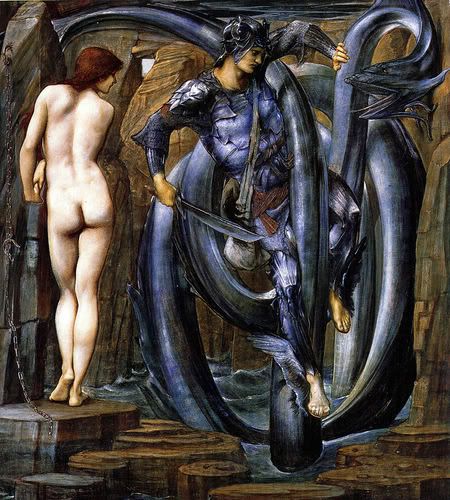
That's Perseus. As for Andromeda, her father has chained her to a rock to be enjoyed by a sea monster: and she's gone along with it! She really needs to learn to pull a gorgon face.   ;


Sunday, 29 April 2012

Sympathy for The Gorgon, Part 2

Athena wearing the Aegis, from the tale
of Jason and the Golden Fleece 
In this image, Athena is seen defeating a sea monster. She bears the gorgon's head on her breastplate, the Aegis.  This word aegis signified various things, including a violent wind and a shield. Are we to infer that the horrid gaze of Medusa is Athena's last and most powerful line of defence? Athena represents rational strategy and planning, the rule of law, and social order... but when attacked, she will employ a more primal power?

The Gorgons are an ancient branch in the family tree of gods and titans... more ancient than Athena, and her Johnny-come-lately kinsfolk. In one account, they were spawned by the primal sea deity Phorcys, and are therefore grandchildren of Gaia, mother earth. The gorgons are monstrous forces of nature.

So what is the Gorgon Medusa doing as a mortal skivvy in Athena's temple?  Could it be that Medusa's humanity depends on her paying homage to rationality, purity and wisdom? Or  is the great poet Ovid just playing loose with the original legend in order to spin his yarn?

If you ask me (and you may as well - you read this far already... good for you) poetic licence is being put to excellent use here: Medusa's personality in the original was a bit too one-sided, and so was Athena's. It was just a case of good goddess v. bad gorgon. Ovid adds a twist. In his version, Athena is way too much of a Type A personality (a narcissist, we might add) and  Medusa is a Type C (some would say schizoid-oral). Athena goes around with a pickle up her arse: overbearing, officiously godly and deeply intolerant of playboys, tramps and unwashed hippies. Medusa is a compulsive caretaker, who sees others' needs as more important than her own. She can't express anger, and can't say no effectively.

Then along came a randy Poseidon.

Now, the goddess is well known for giving short shrift to lechery (she speared Hephaestos in the crotch for getting too feisty), so she ain't no easy lay. Even so she surely reckons she's the only broad worth having in that particular temple, and she would like the attention - just with a little more wooing... and less rape. Poseidon, however, picks Medusa. This should be no surprise: Medusa's demure exterior only barely conceals her heaving, monstrous sexual appetite - whether she knows it or not.

Poseidon knows.

And so, with little further a-do, the poor Gorgon is left with all her illusions shattered, traumatised and distraught. But Athena can't see it that way: her wrath is not directed at Poseidon: sea-gods will be sea-gods after all. She feels rejected by him, but takes it out on Medusa, projecting all her anger and sexual frustration onto the Gorgon, who is much more in touch with her passionate side... Even though poor Medusa was scrupulously avoiding those passions all along, as best she could.

Oh, Woe!

And there we leave our sad tale for now. Athena (being an eternal archetype of the mind) may never loosen up and get herself a toyboy. Medusa will always be just another snaky head in a bag, c'est la mythe grecque.

But we mortals are a bit more resilient, and can recover from such nastiness. Find out how in Part III, when we look at Perseus, Danae, and Andromeda. Stay tuned folks. ;      

Tuesday, 6 March 2012

Sympathy for the Gorgon, Part 1

Medusa gets a raw deal. The poor snake-haired, hideously-deformed, boggle-eyed, lithogenic hag was made to play the role of Victim in an early performance of Blaming the Victim - one of Western Civilisation's most cherished and regular productions.

As we are all aware - if only from watching the slaughter of plastic monsters in the original Clash of the Titans movie (or the plastic acting of the recent remake) - Medusa is a heinous slug beast that gets her comeuppance at the hands of mighty Perseus, who goes on to use her severed head to petrify a sea monster, and rescue the fair Andromeda.  Or something like that.

Well, I discovered the back-story to the Medusa myth today*, and it paints her in a more favourable, but tragic light. In this version, Medusa starts her life as a chaste and dutiful young lady. Unlike her ugly sisters, Stheno and Euryale, Medusa is a good kid, and enjoys nothing better than tending fires and polishing statues Cinderella-style, in the Parthenon: the home of Athena - everybody's favourite ever-virgin goddess of wisdom.
     That's just about working out for Medusa, until Poseidon takes a shine to her, and in typically Olympian style, he dispenses with courtship, and ravishes Medusa, right there in Athena's temple. Now you might well suppose that Athena should be miffed at Poseidon for rudely deflowering her serving girl in such a manner: but No! This is Greek Myth, and the gods are capricious. Medusa gets a scalp-load of asps, and a one way ticket to Hades, sine die. Any man who looks at her will be turned to stone.

So what can we make of this new evidence?  I'm moving for acquittal in the case of History v. M. Gorgon. I'll explain my reasoning now, and I'll also show that some of the theories used  in the 20th c. to interpret myths are outdated, and need to be supplemented with new ideas.

1) It's been suggested before** that the doctrine of Athena's perpetual maidenhood was introduced as a patriarchal ploy, intended to remind women that engaging in illicit sexual activity is the opposite of wisdom, and will result in severe punishment. Allowing oneself to be raped is equally unwise and punishable. I can agree that the story probably did serve this 'moral' function...ie  it's all Medusa's own fault, she must have been behaving improperly - polishing the statues seductively, being in the temple without a chaperone, or whatever... So that's where the 'blaming the victim' charge comes in. But I'm not resting my case just yet.

2) When the whole myth is interpreted as a piece, and with a psychodynamic slant, a more humane ethic can be discerned. For one thing, the serpentine sea monster, Cetus, sent by Poseidon to take the helplessly bound maiden Andromeda, is about as clear a phallic symbol as ever slipped out of the sick mind of Sigmund Freud. It is defeated by the disfigured face of Medusa, Poseidon's earlier victim. This  suggests a kind of aversion therapy... the abuser is made to look at the result of his abuse, and loses the power to re-offend: shame and guilt lead to remorse...
        It's worth noting here that the defeat of Poseidon's lust - Athena's revenge by proxy - does not come about until after Medusa's head has been separated  from her body. Poseidon is made at last  to see the injured psyche of the Gorgon - and can no longer see her sexual aspect. She becomes the suffering subject, no longer merely an object of lust.

The points above might all be made within the framework of 'traditional' Freudian theory, or mythological analysis as practised by Jung or Joseph Campbell. The focus is on the power struggle between the unbridled, unthinking male libido of the sea god,  and Athena's demure chastity: Id against Superego; The Anima as guide to a higher consciousness. Fair enough, I guess - this is as far as the exegesis of legends and fairy tales in psychological terms usually gets.

3) What interests me more though, is the role played by the 'minor', mortal characters: Perseus, Medusa, Andromeda, Danae. I believe the whole myth presents a paradigm for dealing with, and recovering from, traumatic abuse - including rape, incest and pederasty. I'll expand on this point, and on the significance of each mortal character in parts 2 and 3 of this post.

*Ovid, Metamorphoses 4.770 (according to the Oracle of Wikipedia)
** I recall reading point 1 somewhere, but can't find the quote at the moment. I'll update this footnote asap!